The Freedom of Not Knowing

Uncertainty does not have to feel like a threat. It can become space.
There is a quiet pressure in modern life to have an answer for everything.
Political opinions. Philosophical positions. Career trajectories. Identity labels. Life plans.
We are rewarded for clarity. For decisiveness. For confident declarations.
But beneath that pressure sits something more primitive:
The need to know.
And when we cannot know, something in us tightens.
The Burden of Needing to Know
Ambiguity is uncomfortable.
When a question remains unresolved, the mind does not simply let it float. It searches. It reaches. It wants closure.
Psychologists describe this as a need for cognitive closure — the motivational pull to arrive at an answer and lock it in. When uncertainty lingers, we tend to “seize” the first plausible explanation and then “freeze” around it.
This is not a flaw in character. It is a feature of cognition.
Unresolved uncertainty consumes energy. It keeps prediction systems active. It maintains vigilance.
The problem is not that we seek answers.
The problem is when we treat premature answers as relief.
Why Uncertainty Feels Threatening
The brain is a prediction engine.
It constantly anticipates outcomes and adjusts based on error signals. When predictions fail or when outcomes remain unknown, the system registers discrepancy.
That discrepancy feels like tension.
Research in anxiety shows that intolerance of uncertainty is one of the strongest drivers of persistent worry. The unknown activates threat systems. Multiple possible interpretations compete for attention.
Some researchers describe this as psychological entropy — a state where too many possible outcomes remain unresolved. The mind interprets this entropy as destabilizing.
Rumination often follows. We loop through possibilities, replay scenarios, and attempt to simulate our way into certainty.
But simulation is not resolution.
And prolonged rumination does not create clarity. It amplifies strain.
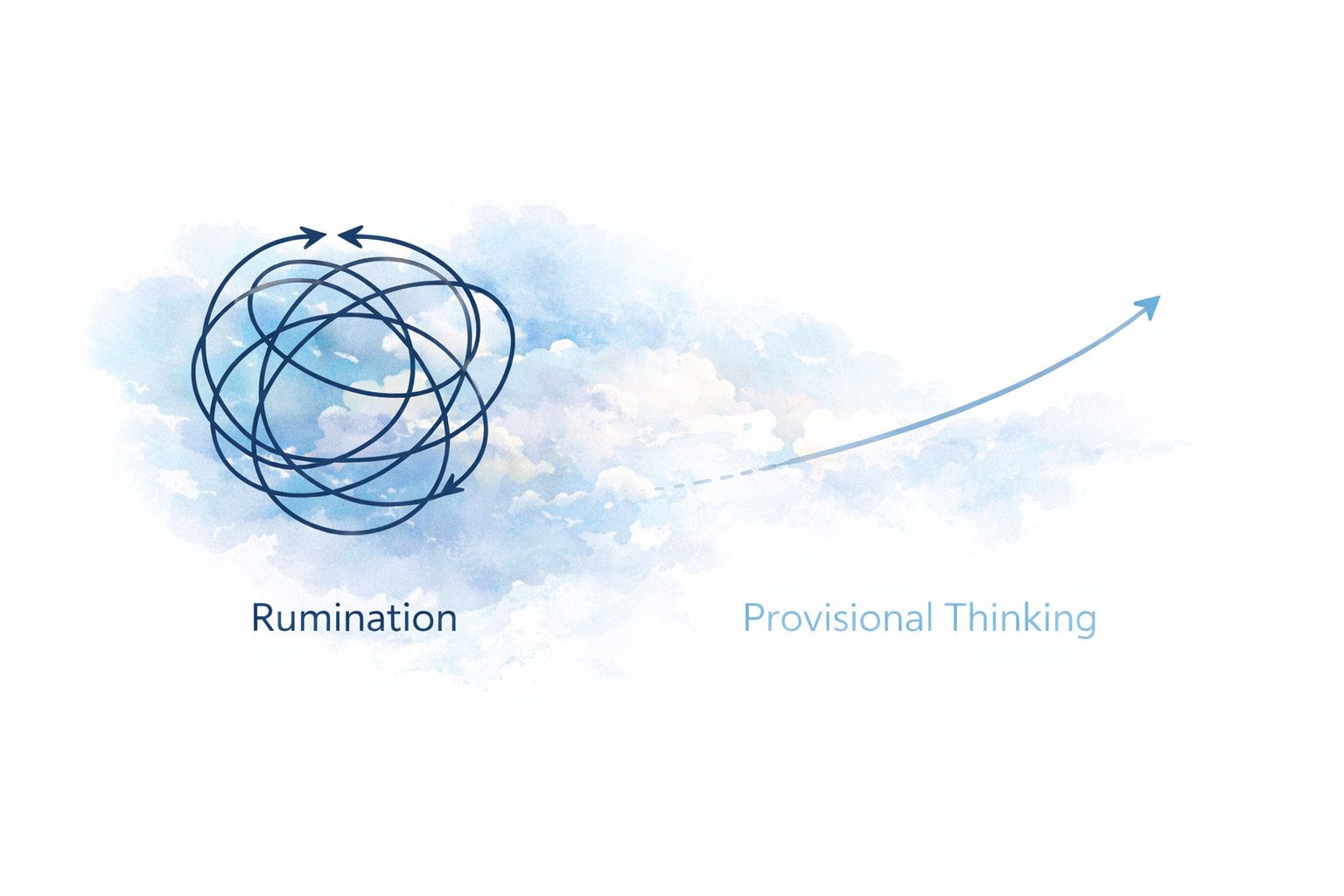
Rumination traps energy in closed loops. Provisional thinking creates forward movement.
Relief Through Release
There is another option.
Instead of forcing resolution, we can allow provisionality.
Not ignorance. Not apathy.
Provisionality.
The simple recognition:
“I do not know this fully — and that is acceptable.”
When the demand for ultimate answers loosens, something subtle shifts in the nervous system.
The loop slows.
Energy reallocates.
Attention stabilizes.
This is not mystical surrender. It is cognitive regulation.
Relief comes not from answers themselves, but from releasing the insistence on having them immediately.
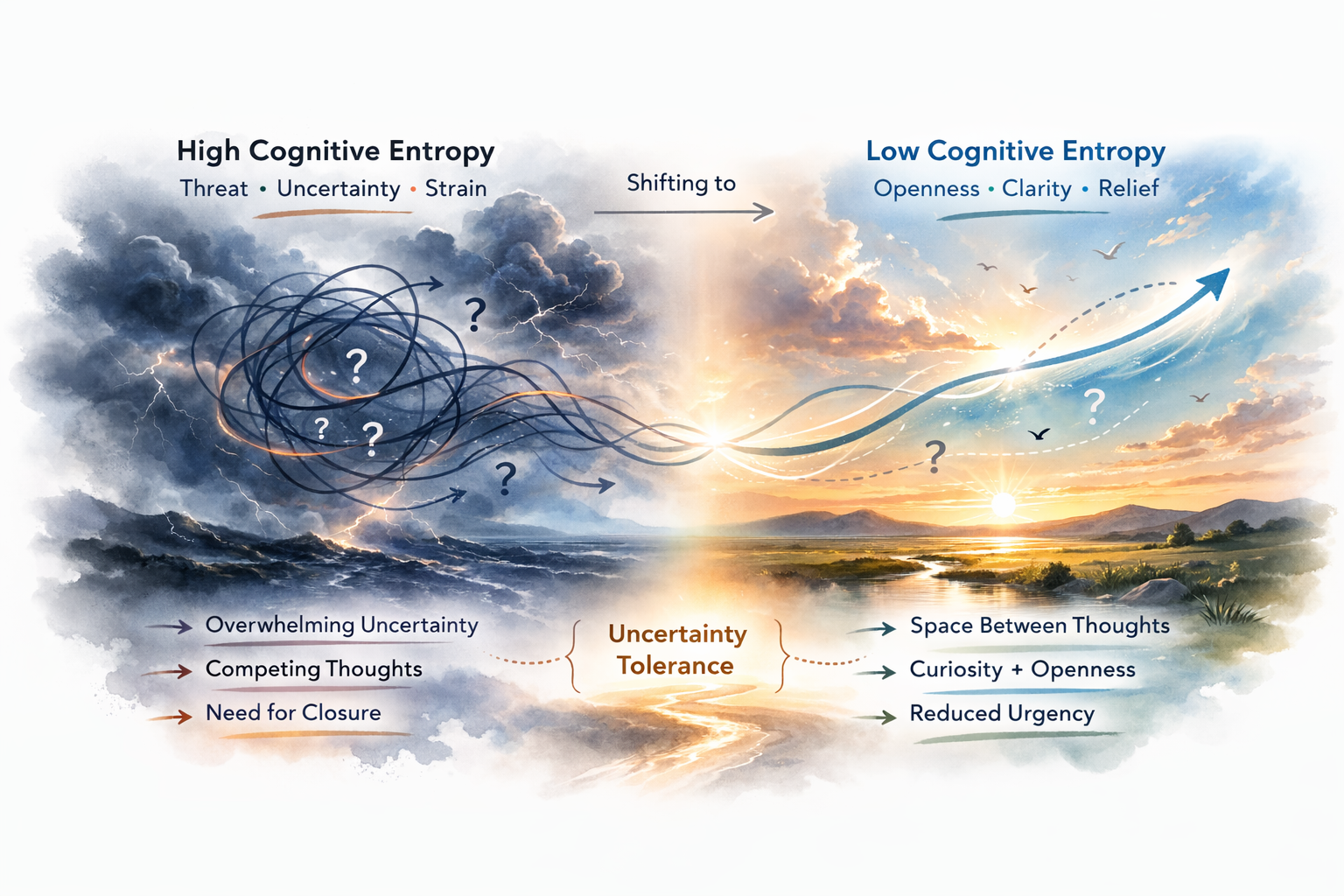
High cognitive entropy feels like threat. Uncertainty tolerance transforms strain into openness.
Freedom and Creativity
There is a second effect.
When we are not gripping certainty, our thinking expands.
Creative work thrives in ambiguity. Design space opens when solutions are not prematurely locked. Exploration becomes possible when identity is not fused to a single position.
Psychological flexibility — the ability to adapt thoughts and behavior in response to changing information — is strongly associated with well-being.
Not knowing, when held correctly, is not paralysis.
It is space.
Space to explore.
Space to update.
Space to choose deliberately rather than reactively.
Practicing Not Knowing
Freedom from forced certainty does not happen automatically. It can be practiced.
A simple sequence helps:
- Notice the trigger.
- Pause before closure.
- Reframe the thought as provisional.
- Continue acting without demanding finality.
This does not mean abandoning responsibility.
It means resisting premature certainty.
It means increasing tolerance for cognitive entropy without collapsing into it.
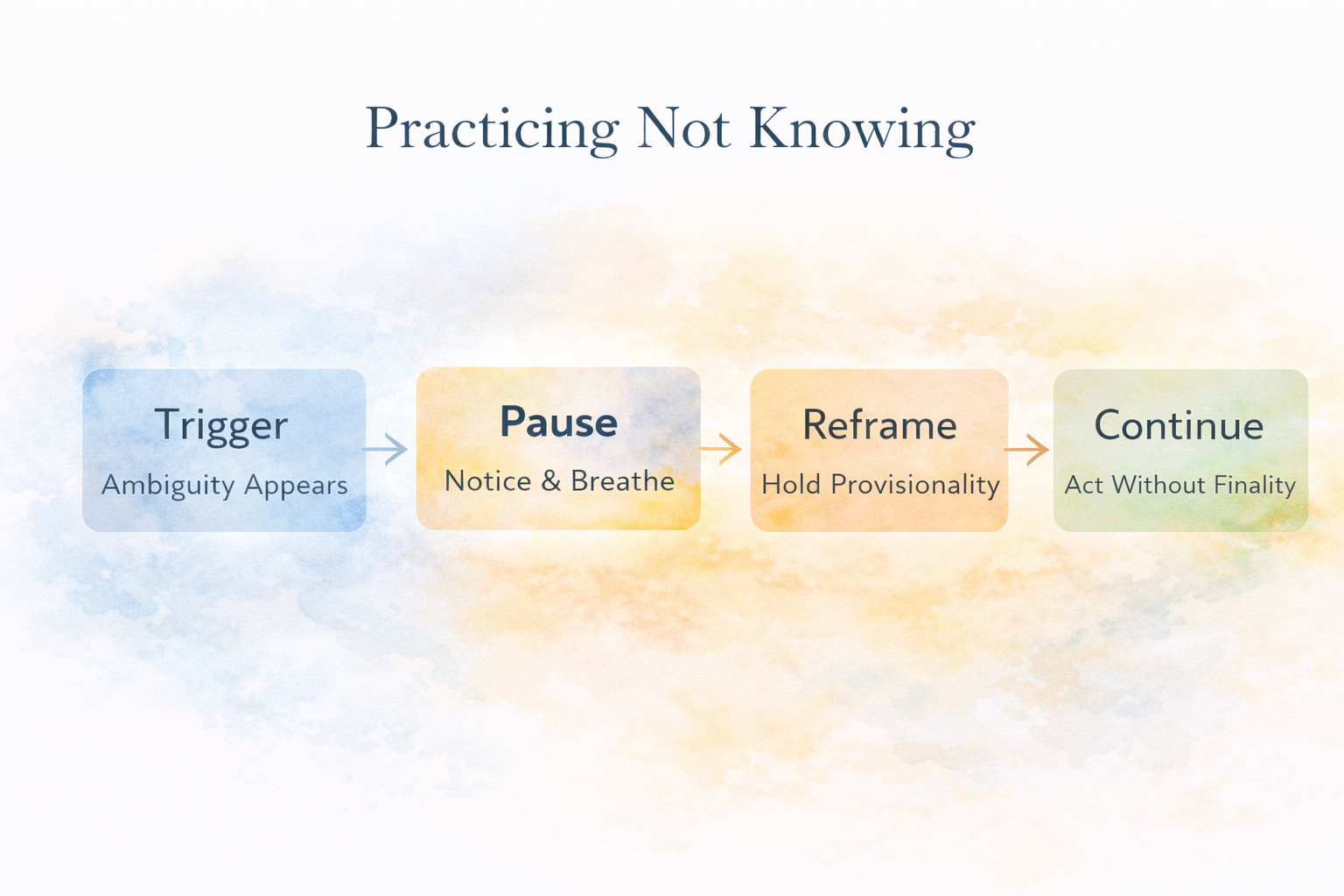
Practicing not knowing is an intervention: pause, hold provisionality, then continue with steadiness.
Closing Reflection
You will not answer every philosophical question.
You will not resolve every ambiguity in your life.
You will not eliminate uncertainty from the human condition.
But you do not need to.
When the demand for absolute knowing softens, something steadier takes its place.
Clarity without rigidity.
Curiosity without panic.
Freedom without denial.
Not knowing is not a failure of intelligence.
Sometimes, it is its maturation.