Living Without Absolute Answers

Our models are precise. The horizon always extends beyond them.
I used to think intellectual maturity meant getting closer to certainty.
Better models. Fewer contradictions. Cleaner explanations. A more stable philosophical ground.
But the deeper I went—into engineering, into philosophy, into lived experience—the more obvious something became:
Absolute metaphysical certainty is unavailable.
And yet systems still run. Bridges still stand. Code still compiles. Life still unfolds.
So maybe certainty was never the point.
The Illusion of Absolute Certainty
Human cognition craves closure. Ambiguity consumes energy. Open loops create tension.
In professional environments—especially engineering cultures—confidence is rewarded. Clear answers move projects forward. Definitive statements signal competence.
But psychological certainty and epistemic justification are not the same thing.
Scientific history makes this clear. Frameworks evolve. Models expand. Assumptions are revised. What once felt complete becomes partial. What once seemed foundational becomes contextual.
And still, engineers build.
They do not wait for final metaphysical closure before acting. They operate with the best models available at the time.
The desire for absolute certainty is psychological.
The discipline of high-confidence modeling is practical.
That distinction changes everything.
Models, Not Truths
Science does not deliver ultimate proclamations. It constructs models.
A model is a compression of reality—structured, simplified, and usable. It is not reality itself.
Reliability is not ontology.
A bridge stands not because we understand ultimate reality, but because our stress calculations are sufficiently predictive within known constraints. A distributed system functions not because failure is impossible, but because failure is accounted for.
Probabilistic reasoning formalizes this posture: confidence adjusts with evidence. Beliefs update. Nothing is treated as infallible.
Operating with high-confidence models is not intellectual weakness.
It is disciplined humility.
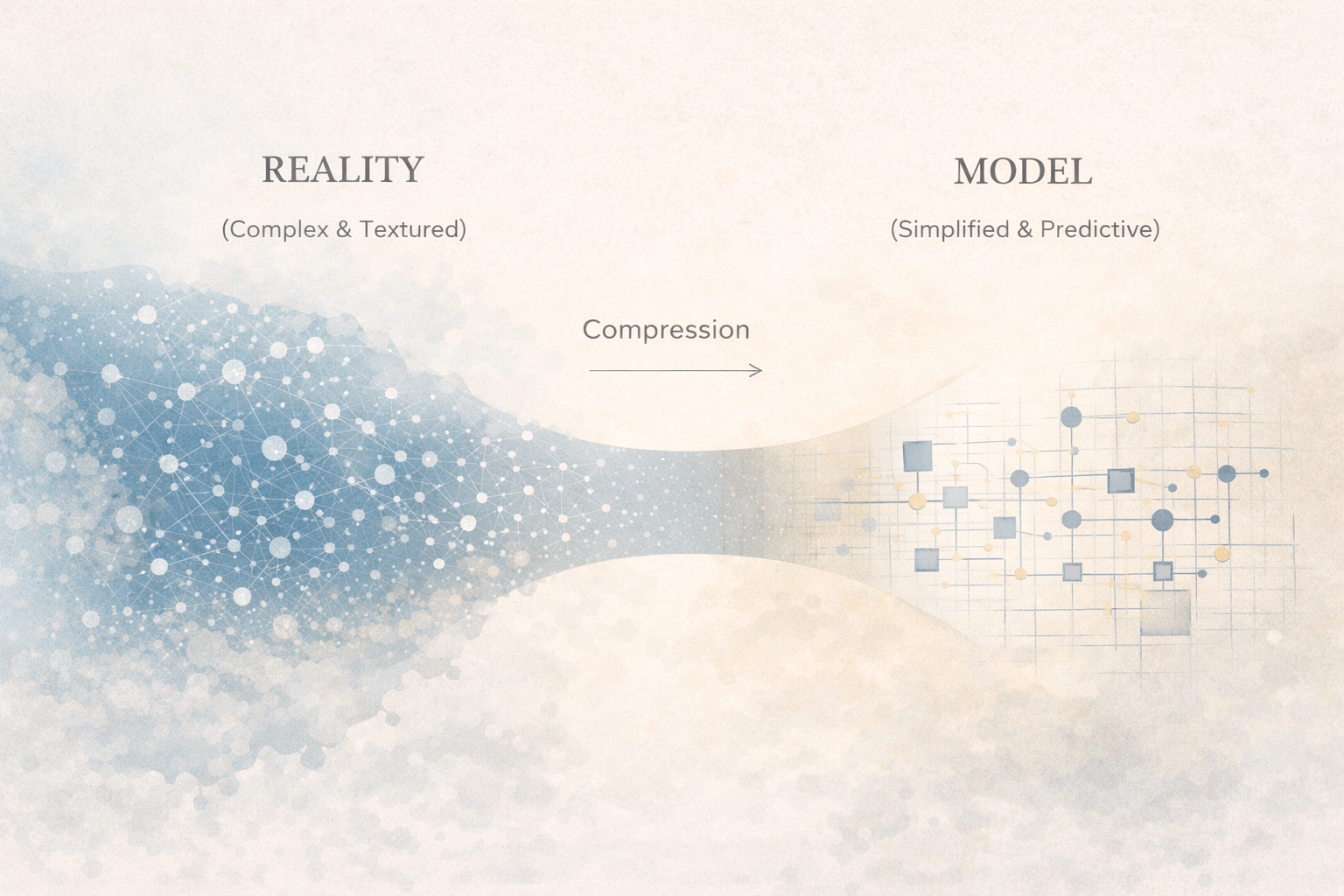
Complex reality must be compressed into structured models before it becomes usable.
The Cost of Rigid Ideology
When belief fuses with identity, flexibility collapses.
Rigid certainty creates fragility. Any contradiction becomes a threat. Revision feels like failure.
On the opposite extreme, radical skepticism dissolves structure. If nothing can be known at all, action becomes paralyzed.
Dogmatism and nihilism appear opposed, but psychologically they share instability.
For technically trained minds, this tension can be subtle. We want coherent systems. We want clean abstractions. We want resolution.
But forcing resolution beyond evidence produces ideological
rigidity.
Abandoning resolution entirely produces collapse.
Stability lives between those extremes.
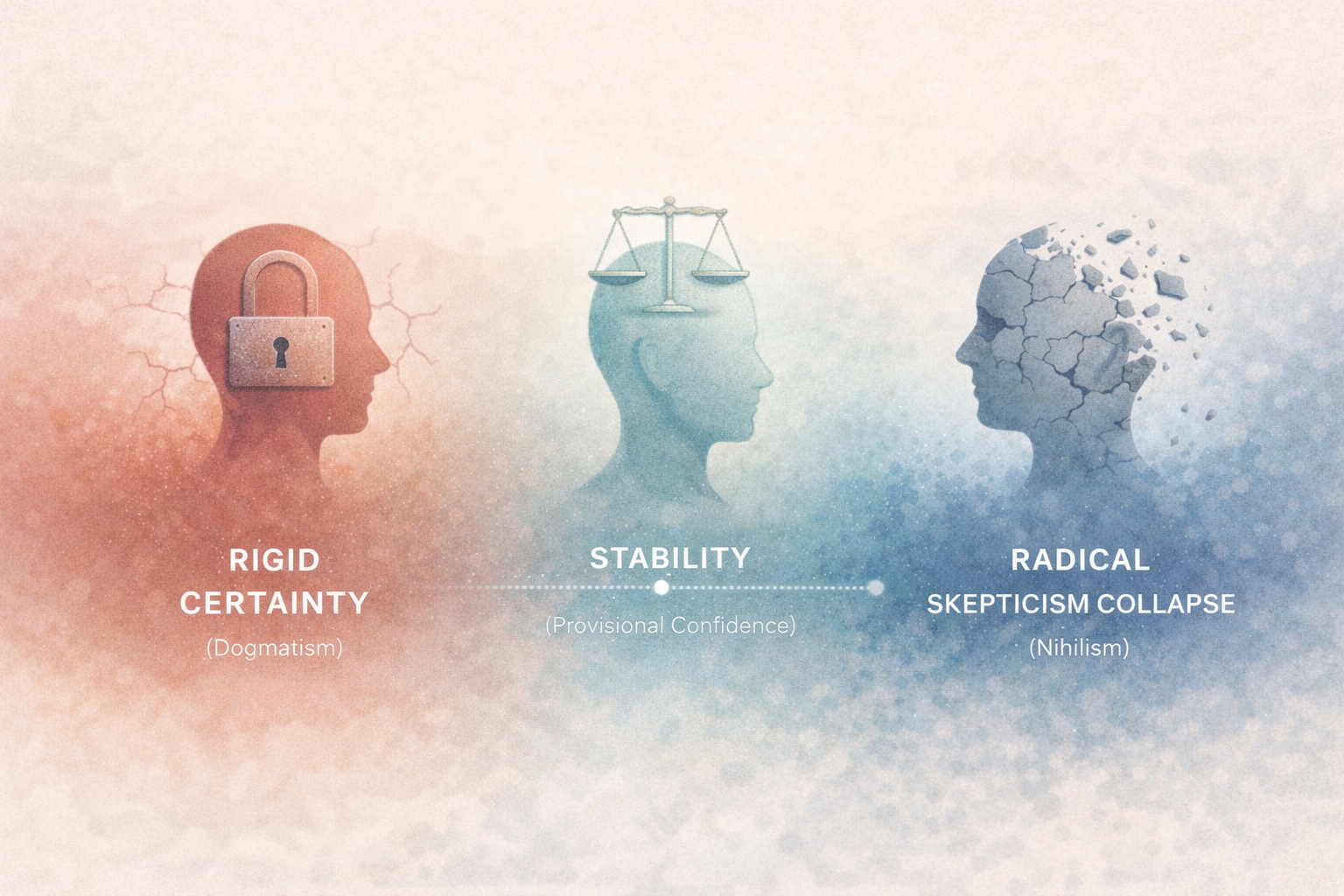
Psychological stability lives between rigid certainty and total collapse.
Operating with High-Confidence Models
Engineers already operate under uncertainty.
Load tolerances include margins. Distributed systems assume partial failure. Machine learning models output probabilities, not guarantees.
We design for reliability within limits.
What if that posture extended beyond engineering?
You do not need metaphysical certainty to live well.
You need models that work reliably enough to move forward.
“I can’t know with metaphysical certainty, but I can operate with high-confidence models.”
That sentence is not resignation. It is freedom.
It allows action without absolutism.
Humility without paralysis.
It preserves agency without pretending to omniscience.
Intellectual Hygiene
Certainty is not a destination. It is a maintenance problem.
Beliefs require updating.
Models require revision.
Assumptions require inspection.
This is not existential crisis. It is system upkeep.
Intellectual hygiene means:
- Separating identity from belief.
- Updating when evidence shifts.
- Holding confidence proportionally to support.
- Allowing revision without ego collapse.
Balance is not perfection.
It is iteration.
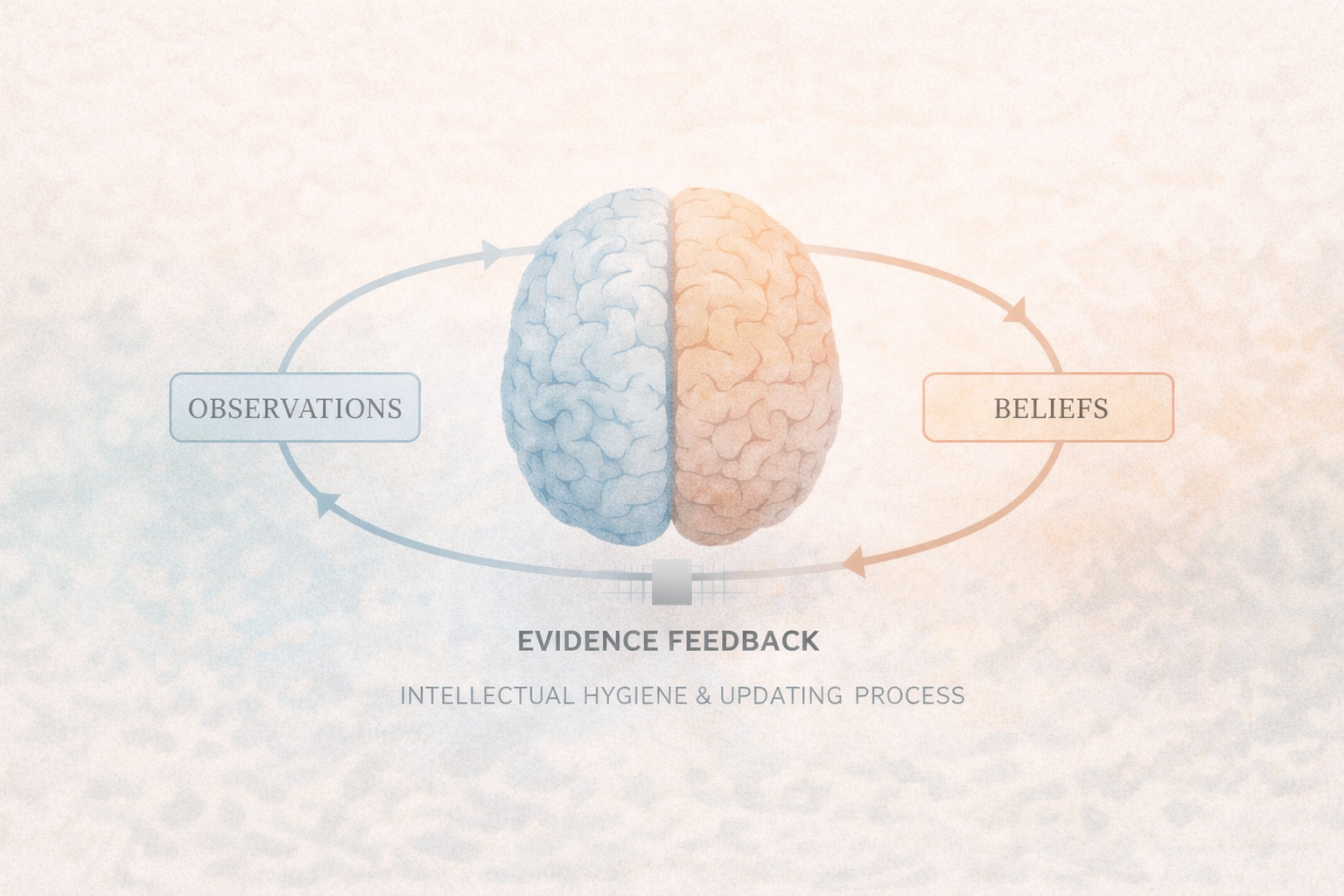
Experience feeds evidence. Evidence updates models. Stability emerges from iteration.
Closing Reflection
You will not solve reality.
You will not eliminate uncertainty.
You will not reach final epistemic ground.
But you can operate intelligently.
You can design systems that work.
You can revise when they fail.
You can hold paradox without breaking.
Absolute answers are not required.
High-confidence models are enough.
References
Peirce, C. S. (1877). The Fixation of Belief. Popular Science Monthly.
Kuhn, T. S. (1962). The Structure of Scientific Revolutions. University of Chicago Press.
Friston, K. (2010). The free-energy principle: a unified brain theory? Nature Reviews Neuroscience, 11(2), 127–138. https://doi.org/10.1038/nrn2787
Clark, A. (2013). Whatever next? Predictive brains, situated agents, and the future of cognitive science. Behavioral and Brain Sciences, 36(3), 181–204. https://doi.org/10.1017/S0140525X12000477
Dunning, D., & Kruger, J. (1999). Unskilled and unaware of it. Journal of Personality and Social Psychology, 77(6), 1121–1134. https://doi.org/10.1037/0022-3514.77.6.1121
Nickerson, R. S. (1998). Confirmation bias: A ubiquitous phenomenon in many guises. Review of General Psychology, 2(2), 175–220. https://doi.org/10.1037/1089-2680.2.2.175