Holding Paradox Without Breaking

Different models can describe the same reality. Paradox appears when we mistake the model for the whole.
At some point, every thoughtful person runs into contradictions.
Two ideas both seem true.
Two explanations both work.
Two perspectives refuse to collapse into a single answer.
The instinct is to resolve the tension quickly.
Pick a side.
Choose the cleaner explanation.
Remove the ambiguity.
But the deeper we look into complex systems — scientific, social, or personal — the more often we encounter paradox.
Paradox: an apparent contradiction that arises when different models or perspectives describe the same system, each capturing part of the truth but none capturing the whole.
Paradox is not necessarily a failure of logic.
More often, it is a signal that the system being described is more
complex than the framework being used to explain it.
Why the Mind Rejects Paradox
Human cognition evolved to simplify.
The brain constantly builds predictions about the world. When those predictions collide, tension appears. Ambiguity requires energy. Contradictions create instability.
So the mind looks for closure.
Right or wrong.
True or false.
Meaningful or meaningless.
Binary categories reduce cognitive load.
But they also hide complexity.
When paradox appears, it often signals that the system being described cannot be fully captured by a single framework.
When Systems Produce Contradictions
In simple systems, contradictions usually indicate an error.
But in complex systems, contradictions can arise from perspective.
Different vantage points reveal different aspects of the same structure.
Physics provides a classic example: light behaves like both a particle and a wave depending on how it is measured.
Neither model is completely wrong.
Neither model is completely complete.
The paradox exists because each perspective reveals something real while hiding something else.

Contradictions often arise when different perspectives describe the same system. Each view is internally consistent, but none captures the full structure alone.
The Collapse Into Simplicity
Faced with paradox, people often collapse into simpler answers.
One strategy is dogma.
Dogma insists that one model must be correct, and contradictions are treated as threats that must be eliminated.
Another strategy is nihilism.
Nihilism dissolves meaning entirely, rejecting the idea that any explanation matters.
Both strategies reduce cognitive tension.
Both remove ambiguity.
And both sacrifice understanding.
Identity Fusion
The deeper issue is not belief content.
It is identity fusion.
When belief fuses with identity, flexibility disappears.
If I am my ideology, disagreement becomes
threat.
If I am my skepticism, commitment becomes
weakness.
If I am my doubt, conviction becomes betrayal.
The mind is not defending truth.
It is defending identity.
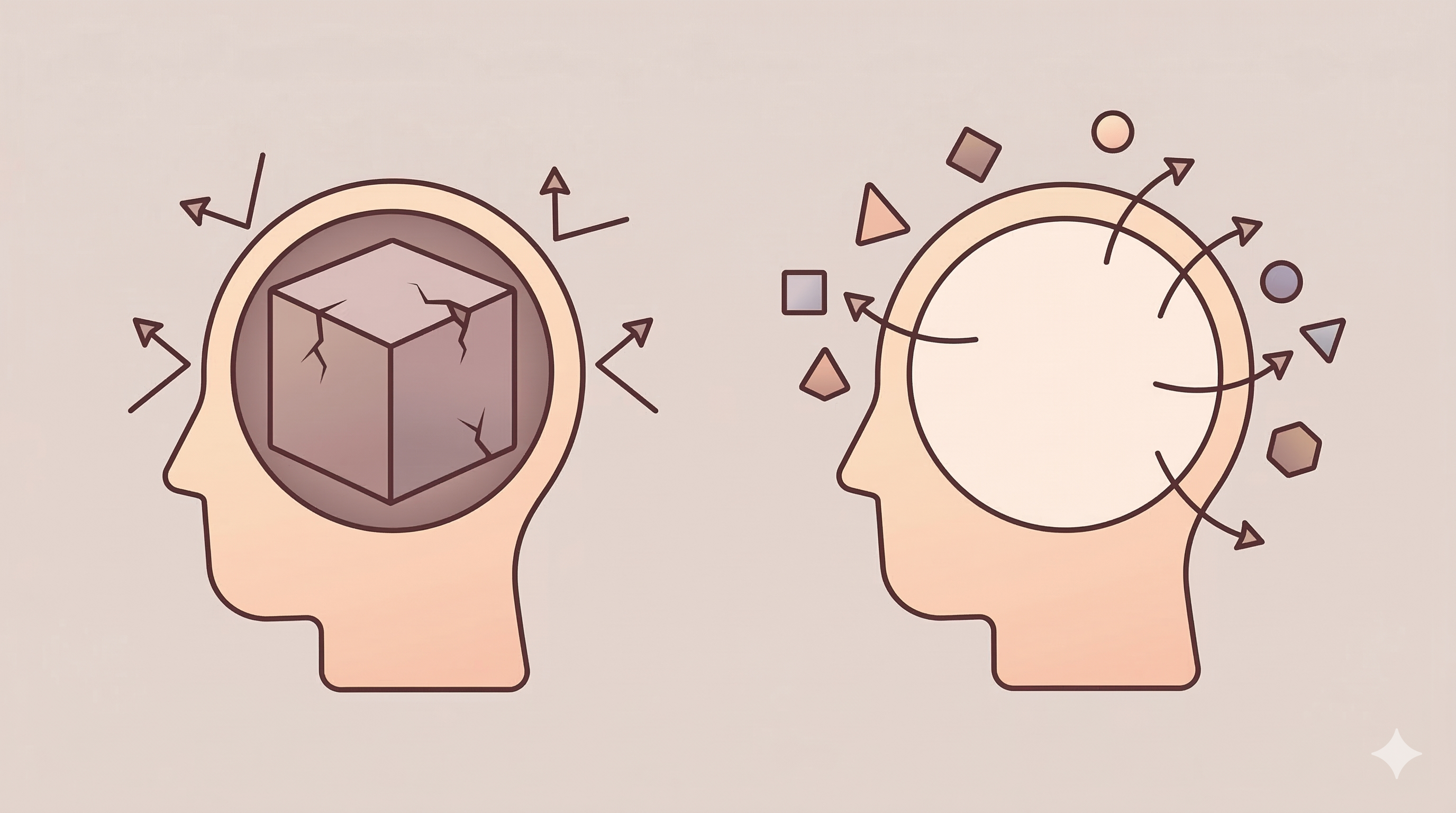
When beliefs fuse with identity, disagreement feels like a personal threat. Separating identity from belief allows ideas to evolve without destabilizing the self.
The Imagined Outside View
Paradox often arises because we are reasoning from within the system we are trying to understand.
Human thinking is inherently dualistic.
We divide the world into observer and observed.
Subject and object.
Model and reality.
These distinctions are useful, but they also create the conditions for contradiction.
If we imagine a perspective without those separations — a purely non-dual viewpoint — the paradox dissolves because the distinction itself disappears.
Humans cannot fully occupy that perspective.
But imagining it reveals something important:
Many paradoxes are not flaws in reality.
They are artifacts of how our models divide the world.
Stability in the Middle
The middle position is less dramatic.
It does not claim absolute certainty.
It does not abandon meaning entirely.
Instead, it allows conviction without rigidity.
Beliefs remain strong but revisable.
Questions remain open without collapsing into nothingness.
Identity becomes separate from ideology.
This posture requires discipline.
It means tolerating ambiguity without demanding immediate resolution.
It means allowing beliefs to update without feeling like the self is under attack.
But it creates something rare:
Stability without rigidity.

Complex systems are often best understood through multiple models. Stability emerges when different perspectives are held together rather than forced into a single view.
Closing Reflection
Dogma promises certainty.
Nothingness promises freedom.
Both offer relief from ambiguity.
But relief purchased through rigidity is fragile.
The alternative is quieter.
Hold belief lightly.
Hold doubt responsibly.
Separate identity from ideology.
Truth-seeking is not a fixed position.
References
Kruglanski, A. W., & Webster, D. M. (1996). Motivated closing of the mind: “Seizing” and “Freezing.” Psychological Review, 103(2), 263–283. https://doi.org/10.1037/0033-295X.103.2.263
Carleton, R. N. (2016). Fear of the unknown: One fear to rule them all? Journal of Anxiety Disorders, 41, 5–21. https://doi.org/10.1016/j.janxdis.2016.03.011
Hirsh, J. B., Mar, R. A., & Peterson, J. B. (2012). Psychological entropy: A framework for understanding uncertainty-related anxiety. Psychological Review, 119(2), 304–320. https://doi.org/10.1037/a0026767
Nolen-Hoeksema, S. (2000). The role of rumination in depressive disorders and mixed anxiety/depressive symptoms. Journal of Abnormal Psychology, 109(3), 504–511. https://doi.org/10.1037/0021-843X.109.3.504
Kashdan, T. B., & Rottenberg, J. (2010). Psychological flexibility as a fundamental aspect of health. Clinical Psychology Review, 30(7), 865–878. https://doi.org/10.1016/j.cpr.2010.03.001
Swann, W. B., Gómez, Á., Seyle, D. C., Morales, J. F., & Huici, C. (2009). Identity fusion: The interplay of personal and social identities in extreme group behavior. Journal of Personality and Social Psychology, 96(5), 995–1011. https://doi.org/10.1037/a0013668
Kunda, Z. (1990). The case for motivated reasoning. Psychological Bulletin, 108(3), 480–498. https://doi.org/10.1037/0033-2909.108.3.480
It is the willingness to move.