Crying Is Healing — The Nervous System’s Repair Mechanism

What if crying isn’t a breakdown—but a form of repair?
Introduction
I didn’t plan to cry.
Nothing specific triggered it. No single moment. Just… everything.
Stress. Pressure. Uncertainty. The quiet weight of trying to hold things together.
Earlier that day, I made a decision I didn’t want to make. I submitted paperwork that felt like survival, not progress. I applied to a job. I told myself I was okay.
But something in me wasn’t.
I went for a drive. Music was playing. My thoughts started moving faster. Emotions started shifting—anger, then sadness, then back again.
And then it happened.
It just started flowing.
Not controlled. Not planned.
Just… release.
And afterward, something changed.
Not everything—but enough.
I felt clearer. Lighter. More stable.
Like something inside me had finally moved.
The Misunderstanding of Crying
Crying is often framed as weakness.
Especially in men, but not exclusively. Across the board, it’s treated as something to suppress, hide, or “get under control.”
When someone cries in front of others, people often become uncomfortable.
They assume something is wrong.
They try to fix it.
Or they avoid it altogether.
That discomfort shapes behavior.
People learn to:
- hold it in
- push it down
- disconnect from it entirely
But what if that reaction is based on a misunderstanding?
What if crying is not a malfunction—but a function?
Pressure, Threshold, Release
Emotional stress doesn’t disappear just because it’s ignored.
It accumulates.
Work. Relationships. Identity. Survival. Expectations.
It builds quietly in the background until something shifts.
Not always from a single event—but from crossing a threshold.

Figure 1 — Emotional pressure accumulates until it reaches a threshold. Crying can emerge as a release, allowing the system to move from compression toward flow.
When that threshold is reached, the system looks for a way to release.
Crying is one of those ways.
It can feel sudden. Overwhelming. Even confusing.
But underneath that experience is a pattern:
accumulation → activation → release → regulation
Not a breakdown.
A transition.
Repair Is a Biological Principle
At the cellular level, the body is constantly repairing itself.
Cells detect damage.
They respond.
They rebuild.
They restore function.
This isn’t optional—it’s foundational to survival.
Without repair, systems degrade.
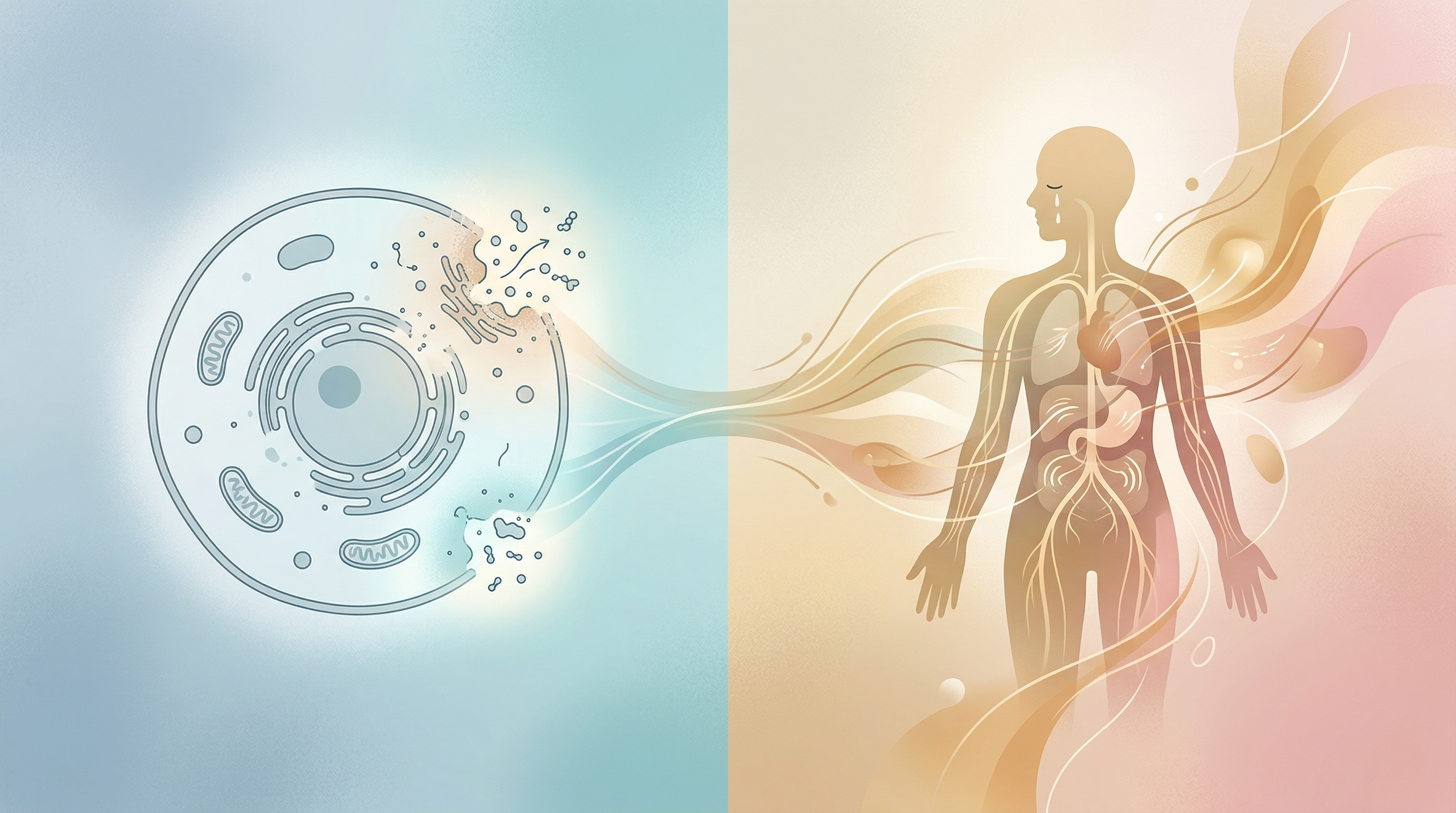
Figure 2 — Biological systems repair physical damage at the cellular level. Emotional systems may require similar processes to resolve accumulated internal stress.
If the body requires repair at the physical level, it raises a question:
What happens when the “damage” is not physical, but emotional?
Where does that go?
Crying as Emotional Repair
Emotional experiences don’t just exist in thought.
They exist in the body.
Stress, anxiety, grief—these are physiological states.
When enough of that load builds up, the system needs a way to process it.
Crying appears to be one of those processes.
Not just expression—but movement.
Not just reaction—but integration.
It often involves:
- shifts in breathing
- activation of the nervous system
- changes in muscle tension
- release of emotional intensity
And importantly:
It can feel destabilizing while it’s happening.
There’s a loss of control.
A dropping of defenses.
A sense of exposure.
That can be uncomfortable—even frightening.
But afterward, many people experience:
- relief
- clarity
- a return toward stability
Crying may function as a form of nervous system repair.
Suppression vs Processing
If emotional signals are not processed, they don’t disappear.
They persist.
Sometimes they show up as:
- chronic anxiety
- emotional numbness
- irritability
- burnout
People often learn to cope by suppressing those signals.
Distraction. Avoidance. Substances. Over-control.
These strategies can reduce intensity in the short term.
But they don’t resolve the underlying load.
Processing is different.
Processing means allowing the system to:
- experience
- move
- integrate
Crying is one pathway for that.
Not the only one—but an important one.
The Experience of Flow
When crying fully happens, it can feel like something shifts from being blocked to moving.
A kind of internal flow.
Emotions that were fragmented or stuck begin to connect and resolve.

Figure 3 — Multiple internal signals—stress, memory, identity, and experience—converge and move through a single process of release and integration.
This can feel intense.
Sometimes even disorienting.
But it can also feel like something deeper is happening—like the system is reorganizing itself.
Not consciously.
But automatically.
Feelings Are Signals, Not Commands
Emotions are often misunderstood in two opposite ways:
- treated as objective truth
- or dismissed entirely
Neither is accurate.
Feelings are not objective reality.
But they are not meaningless either.
They are signals.
They indicate that something is happening within the system.
Suppressing them removes the signal.
Being controlled by them removes agency.
The middle ground is learning to:
- allow them
- observe them
- process them
- without being defined by them
Reframing Crying
If crying is seen as weakness, it will be suppressed.
If it is seen as a functional process, it can be understood differently.
Not something to force.
Not something to avoid.
But something to allow when it arises.
Because sometimes, what looks like losing control…
…is actually the system restoring balance.
Closing Reflection
There are processes in the human system that don’t feel logical in the moment.
They feel overwhelming.
Unstructured.
Difficult to explain.
But that doesn’t mean they are random.
Crying may be one of those processes.
Not a failure of composure.
But a mechanism of repair.
And sometimes, the most stable thing you can do…
…is let it happen.
References
Emotional Regulation & Nervous System
Gross, J. J. (1998). The emerging field of emotion regulation: An
integrative review. Review of General Psychology, 2(3),
271–299.
https://doi.org/10.1037/1089-2680.2.3.271
LeDoux, J. (2000). Emotion circuits in the brain. Annual Review
of Neuroscience, 23, 155–184.
https://doi.org/10.1146/annurev.neuro.23.1.155
Porges, S. W. (2007). The polyvagal perspective. Biological
Psychology, 74(2), 116–143.
https://doi.org/10.1016/j.biopsycho.2006.06.009
McEwen, B. S. (1998). Protective and damaging effects of stress
mediators. New England Journal of Medicine, 338(3),
171–179.
https://doi.org/10.1056/NEJM199801153380307
Crying & Emotional Expression
Vingerhoets, A. J. J. M. (2013). Why Only Humans Weep: Unravelling the Mysteries of Tears. Oxford University Press.
Vingerhoets, A. J. J. M., & Bylsma, L. M. (2016). The riddle of
human emotional crying: A challenge for emotion researchers. Emotion
Review, 8(3), 207–217.
https://doi.org/10.1177/1754073915586226
Bylsma, L. M., Vingerhoets, A. J. J. M., & Rottenberg, J. (2008).
When is crying cathartic? An international study. Journal of
Research in Personality, 42(5), 1165–1178.
https://doi.org/10.1016/j.jrp.2008.03.003
Frey, W. H. (1985). Crying: The mystery of tears. Minneapolis: Winston Press.
Stress, Release, and Regulation Cycles
Sapolsky, R. M. (2004). Why Zebras Don’t Get Ulcers. Holt Paperbacks.
Levine, P. A. (2010). In an Unspoken Voice: How the Body Releases Trauma and Restores Goodness. North Atlantic Books.
van der Kolk, B. A. (2014). The Body Keeps the Score. Viking.
Suppression vs Expression
Gross, J. J., & Levenson, R. W. (1997). Hiding feelings: The
acute effects of inhibiting negative and positive emotion. Journal
of Abnormal Psychology, 106(1), 95–103.
https://doi.org/10.1037/0021-843X.106.1.95
Pennebaker, J. W. (1997). Writing about emotional experiences as a
therapeutic process. Psychological Science, 8(3),
162–166.
https://doi.org/10.1111/j.1467-9280.1997.tb00403.x
Ketamine & Emotional Processing / Integration
Dore, J., Turnipseed, B., Dwyer, S., et al. (2019). Ketamine assisted
psychotherapy (KAP): Patient demographics, clinical data and outcomes in
three large practices. Journal of Psychoactive Drugs, 51(2),
189–198.
https://doi.org/10.1080/02791072.2019.1587556
Dakwar, E., Levin, F., Foltin, R. W., et al. (2014). The effects of
subanesthetic ketamine infusions on motivation to quit and cue-induced
craving in cocaine-dependent research volunteers. Biological
Psychiatry, 76(1), 40–46.
https://doi.org/10.1016/j.biopsych.2013.08.009
Conceptual Foundations (Systems + Mind)
Friston, K. (2010). The free-energy principle: a unified brain
theory? Nature Reviews Neuroscience, 11(2), 127–138.
https://doi.org/10.1038/nrn2787
Clark, A. (2013). Whatever next? Predictive brains, situated agents,
and the future of cognitive science. Behavioral and Brain
Sciences, 36(3), 181–204.
https://doi.org/10.1017/S0140525X12000477